

Nigeria Reviews Progress On National Health Resolutions As Council Meets In Lafia
Dr. Nafisat Makinde, Lafia
Federal and state health authorities are reviewing the implementation of 20 resolutions adopted at the previous National Council on Health, following an assessment that put their overall implementation rate at 55 per cent.
The Director of Health Planning, Research and Statistics at the Federal Ministry of Health and Social Welfare, Dr. John Ovuoraye, disclosed this during the technical session of the 67th National Council on Health in Lafia, Nasarawa State.
The findings were contained in a report issued by the Federal Ministry of Health and Social Welfare and signed by Ado Bako, the ministry’s Assistant Director of Information and Public Relations.
Ovuoraye said all 36 states and the Federal Capital Territory had submitted returns on the 20 resolutions adopted at the 66th Council. However, only 412 of the 740 expected state-level implementation reports had been received, leaving 328 outstanding.
According to the implementation assessment he presented, five resolutions covering sodium reduction, community cardiopulmonary resuscitation, larval source management, cosmetics safety and quality improvement recorded implementation rates below 50 per cent.
The emergency obstetric and newborn care programme recorded an implementation rate of 69.3 per cent, while the emergency preparedness and response plan recorded 67.7 per cent.
To improve implementation, Ovuoraye recommended assigning designated officials to individual resolutions, setting clear timelines and measurable targets, and providing additional technical support to states.
He also proposed that state governments incorporate the resolutions into their 2027 budgets and annual operational plans. Other recommendations included quarterly reporting through the Multi-Source Data Analytics and Triangulation dashboard.
The implementation review formed part of the proceedings of the 67th National Council on Health, which brings together federal and state health officials to discuss policy issues and coordinate healthcare delivery.
The Council’s technical committee session, held on Nov. 16 and 17, considered issues for discussion at the main meeting scheduled for Nov. 19 and 20. The main Council meeting is expected to be chaired by the Coordinating Minister of Health and Social Welfare, Prof. Muhammad Ali Pate.
In her remarks, the Permanent Secretary of the Federal Ministry of Health and Social Welfare and Chair of the Council’s Technical Committee, Daju Kachollom, said the Federal Government remained committed to strengthening primary healthcare, improving disease prevention and promoting cooperation among the federal, state and local governments.
She identified key areas of the ongoing health sector reforms as emergency preparedness, reducing maternal and neonatal deaths, promoting local production of medicines and medical equipment, and tackling communicable and non-communicable diseases, including malaria, HIV/AIDS, tuberculosis, hypertension and diabetes.
Kachollom said primary healthcare centres should serve as the first point of contact for people seeking medical attention. She stressed the need to revitalise the centres, ensure the availability of essential medicines and improve service delivery.
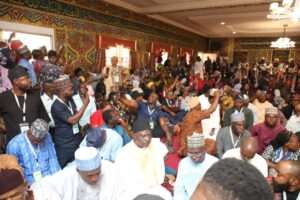
As part of activities preceding the main Council meeting, the technical delegation visited the Emir of Lafia, Justice Sidi Bage Muhammad I (retd.), at his palace in Lafia.
The Emir commended health workers for their service to Nigerians despite the challenges facing the sector and urged them to sustain their efforts to improve healthcare delivery.
He thanked the Federal Government for selecting Nasarawa State to host the meeting and called on governments at all levels to continue addressing insecurity and protecting lives and property.
The Nasarawa State Commissioner for Health, Dr. Gwamna Gaza, also commended the Emir for promoting peaceful coexistence among people of different religious backgrounds in the state.