

Nigeria 2027: Through Machiavelli’s Telescope, A Look At The Politics Of Power
Dr. Nafisat Makinde
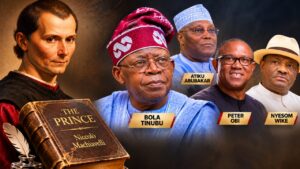
As conversations about Nigeria’s 2027 general election continue to emerge, questions surrounding political power, leadership, influence and survival offer an interesting subject for reflection. Beyond party affiliations and campaign promises, the political personalities involved can also be examined through the ideas of Niccolò Machiavelli, the Italian political philosopher whose writings explored the realities of power and leadership.
In an original political reflection, Engr. Akeju Olagbaju examines Nigeria’s political environment through what he describes as Machiavelli’s telescope. His observations focus on four principles: the relationship between fear and love, the importance of political appearance, the management of difficult decisions and the role of boldness in political survival.
Introducing his argument, Olagbaju writes: “A leader who tries to be always good in a world of bad men will be destroyed.” The observation captures his interpretation of Machiavelli’s political realism and the tension between ideal leadership and the practical demands of political power.
One of the principles Olagbaju highlights is the question of whether it is better for a leader to be loved or feared. In The Prince, Machiavelli explored this dilemma, while also warning that a ruler must avoid becoming hated. Olagbaju uses this principle to examine the different political approaches of President Bola Tinubu, former Vice President Atiku Abubakar, former Anambra State Governor Peter Obi and Nyesom Wike.
For Tinubu, his description is particularly striking. Olagbaju calls him “The Fox Who Learned to Be Lion.” In his interpretation, the fox represents political calculation and the ability to navigate challenges, while the lion represents strength and authority. The description provides an interesting framework for considering the relationship between political organisation, leadership and the exercise of power.
On Atiku, Olagbaju draws attention to Machiavelli’s principle that “Fortune favours the bold.” His observation centres on the relationship between political experience, opportunity and timing. He writes: “A politician who is always perceived as waiting for his turn loses the aura of power.” It is his way of highlighting the importance of decisiveness and the ability to recognise political opportunities.
Peter Obi receives a different characterisation in the original reflection. Olagbaju describes him as “an aspiring leader who relies on love.” The observation considers the role of public affection and popular enthusiasm in political mobilisation. He further poses a question that captures the essence of his argument: “Love can fill a rally, but Machiavelli would ask: will it translate to votes?” The question invites reflection on the relationship between popular support and political organisation.
Olagbaju also considers Wike an important figure in understanding political influence beyond the presidential ballot. His description of him as “the Lion Who Makes Kings and a Fox who exercises caution not to fall into trap” reflects his personal interpretation of Wike’s political style and influence.
Another memorable expression from his analysis is: “A kingmaker who stops being useful becomes a victim.” The observation highlights the changing nature of political alliances and the importance of continued relevance in political calculations.
On political organisation and alliances, Olagbaju offers another interesting formulation: “If you cannot beat the Lion alone, form a pack of Foxes.” His observation draws attention to the role of strategic relationships and collective political interests in the struggle for power.
Taken together, these characterisations provide an interesting reading of Nigerian politics through Machiavelli’s philosophical ideas. They are personal political observations rather than definitive assessments of the individuals concerned, but they raise questions about leadership, public support, experience, alliances and the realities of political survival.
Ultimately, Machiavelli’s telescope, as interpreted by Olagbaju, offers one way of looking at the politics of power. Whether through the strength of political organisation, the appeal of public support, the advantage of experience or the influence of strategic alliances, the political conversation ahead of 2027 remains open to different interpretations.
This commentary is an edited presentation of political observations and original characterisations shared by Engr. Akeju Olagbaju