

Beyond Oil: The Young Entrepreneurs Building Businesses Across Nigeria’s Niger Delta
By Dr Nafisat Makinde
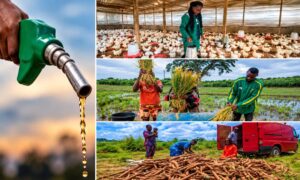
For years, the Niger Delta has been discussed largely through the language of oil, environmental challenges, unemployment and underdevelopment. But across rural communities in the region, another story is taking shape.
Young people and women are turning poultry farms, fish ponds, cassava fields, food processing and other agricultural activities into businesses under the Livelihood Improvement Family Enterprises Project in the Niger Delta, known as LIFE ND.
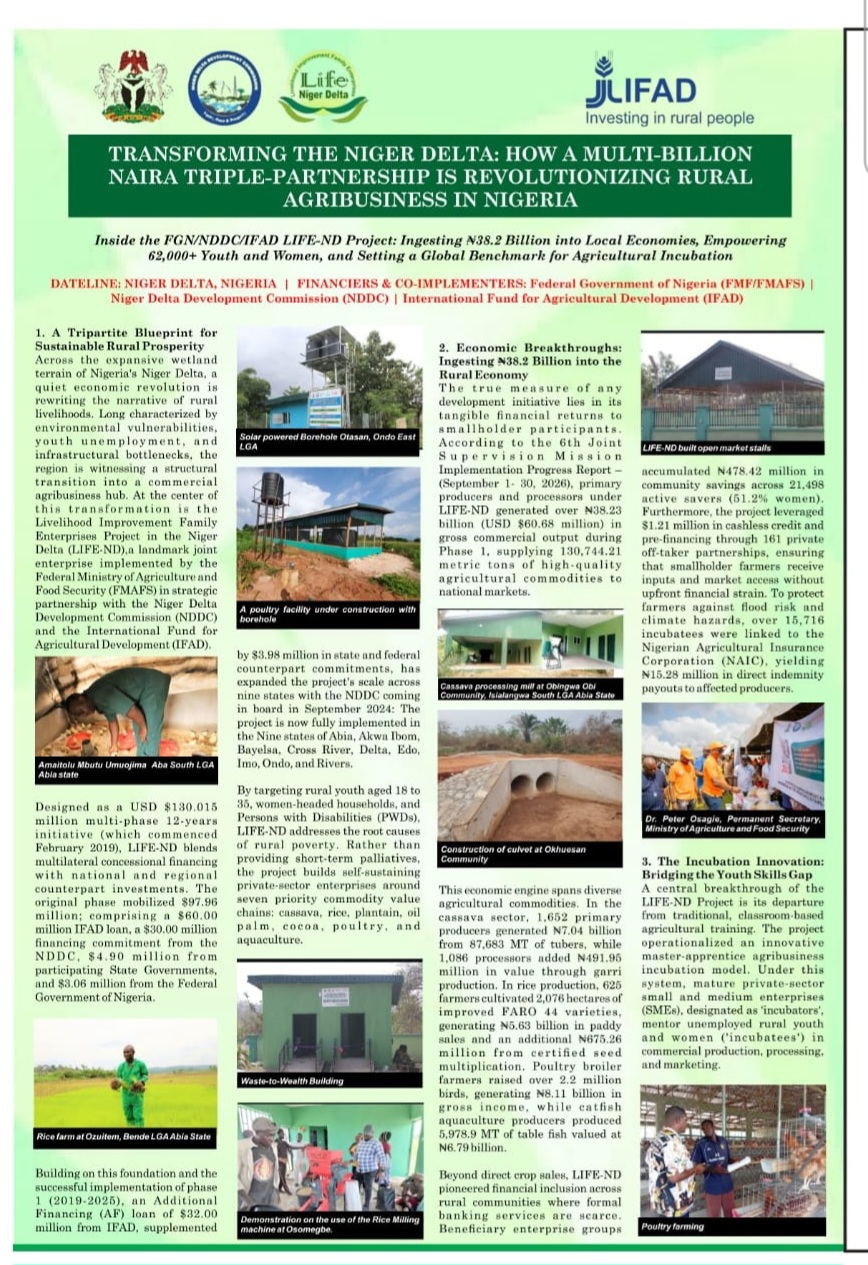
The project, implemented across nine Niger Delta states, has reported reaching 62,612 direct beneficiaries and supporting the establishment of 33,610 agribusiness enterprises. According to figures contained in the project material, supported enterprises have produced 130,744.21 metric tonnes of agricultural output, generating N38.23 billion in gross commercial output.
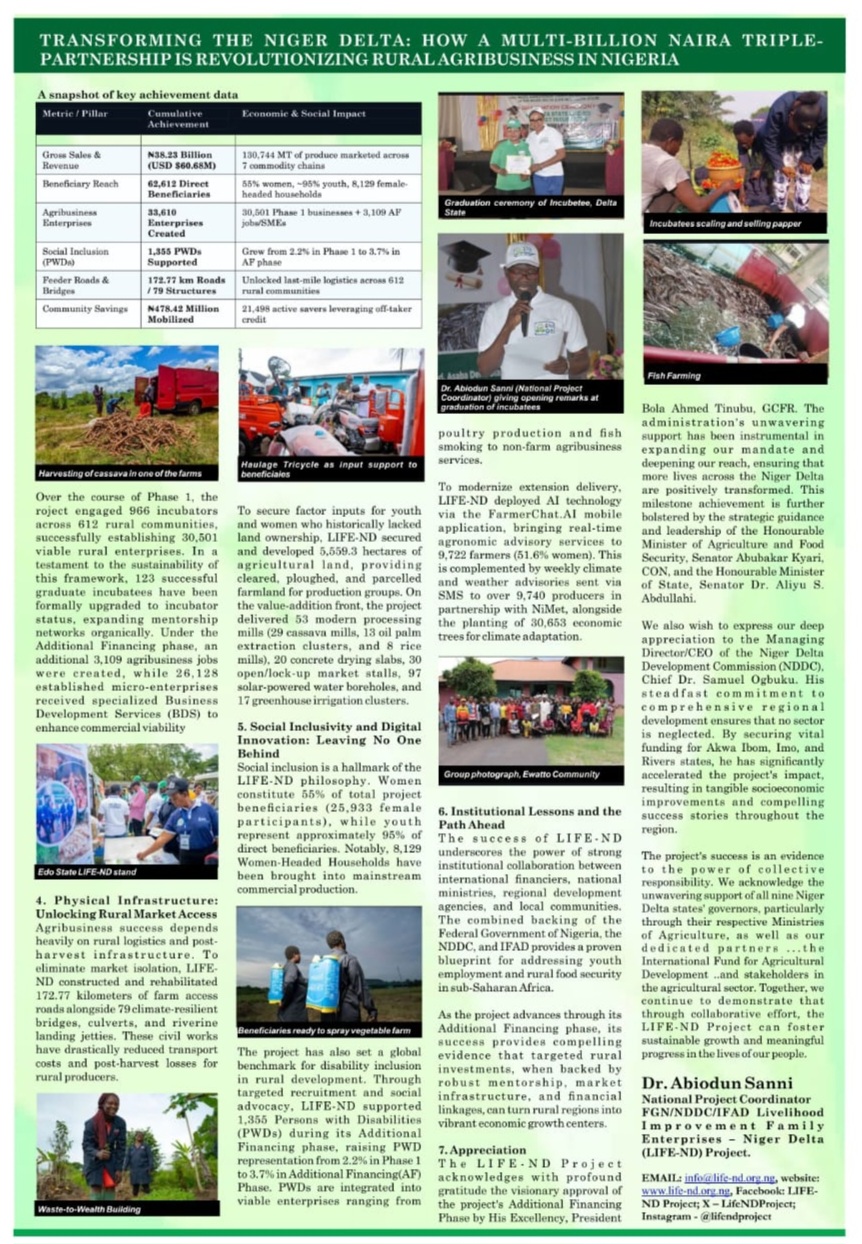
Women account for 55 percent of the 62,612 beneficiaries, representing 34,436 women, while young people make up about 95 percent of participants.
The figures point to a programme operating at significant scale. But beyond the statistics is a more important question: what happens when beneficiaries move from receiving support to running businesses of their own?
From beneficiary to business owner
LIFE ND was designed around an incubation model. Rather than simply distributing agricultural inputs, the programme places participants with established entrepreneurs who provide practical training and business guidance.
The aim is for beneficiaries to progress from trainees to independent entrepreneurs and, eventually, become incubators themselves.
That progression can be seen in the experience of Grace Nwaozuzu in Edo State.
Grace heard about LIFE ND on the radio and joined the programme as an incubatee in 2020 in Ugbineh Community. After completing the programme, she used project support to purchase 100 day old chicks.
She raised and sold 93 birds, making a profit of N120,000, which she reinvested in the business. She later increased her production to at least 200 chicks per cycle.
Her progress eventually took her to another stage of the LIFE ND model. She became an incubator, training other participants in poultry production and passing on the knowledge she had acquired.
According to the United Nations in Nigeria, Grace has used proceeds from her poultry business and other agricultural activities to improve conditions for her family. She and her husband have acquired a car and solar panels, while she continues to train others in poultry production.
Her story illustrates one of the central ideas behind LIFE ND: rural agriculture can become a commercial enterprise when people have access to skills, productive assets and markets.
The International Fund for Agricultural Development, IFAD, describes the project as an effort to help rural youth and women develop entrepreneurial skills and build livelihoods through agriculture, with training covering business development and financial literacy.
Building more than farms
The project’s reported results extend beyond individual farms.
LIFE ND has supported agricultural land development, processing facilities, rural infrastructure and other facilities intended to make production and marketing easier.
The programme has also provided business development services and created links between rural producers, private sector actors and buyers.
That matters because production alone does not guarantee income. A farmer may produce more but still struggle without reliable roads, processing facilities, storage, finance or access to markets.
LIFE ND’s model therefore attempts to connect production with the wider agricultural value chain.
The project operates across nine states: Abia, Akwa Ibom, Bayelsa, Cross River, Delta, Edo, Imo, Ondo and Rivers.
Its original design identified agriculture and rural enterprise development as potential pathways to employment and improved livelihoods for young people and women across the region.
The women behind the numbers
The 34,436 women recorded among the beneficiaries are significant in a region where rural women can face barriers to land, credit and productive assets.
But participation alone does not necessarily translate into lasting economic independence.
An IFAD supervision report noted continuing challenges around women’s access to land, credit and agricultural inputs. It also identified sustainability concerns for some women led enterprises, particularly businesses that remain small scale or dependent on project support.
That distinction is important.
The number of people trained or supported measures the reach of a programme. It does not, by itself, establish whether every enterprise will remain profitable after external support ends.
The sustainability test
For some beneficiaries, that question is already being felt.
In Abia State, retired teacher and widow Violet Oluji Obunna became involved in LIFE ND supported homestead farming, producing vegetables and orange fleshed sweet potatoes.
She told BusinessDay that the programme improved her ability to earn money, feed her household and pay school fees. She also became an incubator, teaching other members of her community.
But her experience also exposes a challenge that development programmes often face after implementation.
A water pumping machine supporting dry season farming broke down. According to BusinessDay, the estimated cost of replacement was about N1.5 million. Obunna said she reported the problem but was told that the project had ended and could do little about the equipment.
Her experience does not erase the benefits she attributes to the programme. Instead, it highlights the gap between helping people establish enterprises and ensuring those enterprises can survive when external support declines.
That gap may ultimately determine how lasting the reported impact of LIFE ND becomes.
Agriculture as enterprise
The project’s reported production figures suggest that the programme has moved beyond small scale training exercises.
Its supported enterprises have generated 130,744.21 metric tonnes of output and N38.23 billion in reported gross commercial output, according to the LIFE ND figures.
The programme has also reported thousands of enterprises across the nine states.
The broader objective is consistent with IFAD’s rationale for the project: using agriculture and rural enterprise development to expand income and employment opportunities for young people and women in a region with substantial agricultural potential.
For communities accustomed to seeing development interventions come and go, however, the ultimate measure will not be the number of training sessions held or enterprises registered.
It will be whether the businesses continue producing, whether their owners can access finance without depending on project funds, whether they can reach profitable markets and whether successful entrepreneurs can continue training others.
Beyond the numbers
LIFE ND is operating in a region where agriculture has long existed alongside the oil economy, but where rural producers have often struggled to turn production into sustainable businesses.
Its incubation approach offers a different proposition: identify experienced entrepreneurs, train new entrants through practical enterprise development, provide productive support and create a pathway for successful beneficiaries to train others.
Grace Nwaozuzu’s transition from incubatee to incubator demonstrates what that model can look like when it works.
Violet Obunna’s experience with a broken piece of essential equipment demonstrates the other side of the equation.
Between those two experiences lies the broader story of LIFE ND.
The programme has produced substantial reported figures in beneficiaries, enterprises and agricultural output. Its longer term significance, however, will depend on whether those enterprises can stand on their own after project support ends.
For the Niger Delta, that may be the more important story than the numbers themselves: whether rural people can build businesses that survive beyond the programme designed to help them start.
Sources: LIFE ND project materials; International Fund for Agricultural Development; United Nations in Nigeria; BusinessDay.