

Unsustainable Media Faces Collapse, Ediri Warns
At launch of “Journalism Next,” author calls for urgent reform in Nigeria’s media industry
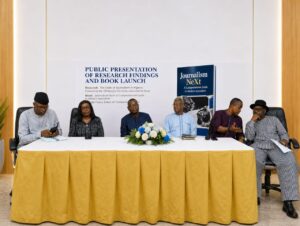
Dr Nafisat Makinde, ABUJA
Journalism in Nigeria risks collapse if media organizations fail to adopt sustainable business models, media entrepreneur Ediri Oyibo warned on Thursday.
Oyibo spoke at the Nigerian Union of Journalists (NUJ) FCT Secretariat in Abuja on Thursday, April 30, 2026, during the public presentation of research findings and the launch of his book, Journalism Next: A Comprehensive Guide to Modern Journalism, which examines the challenges facing journalists in Abuja and across Nigeria.
Journalists, media stakeholders and academics attended the event, including NUJ FCT Council Chairman Grace Ike, former President of the Nigeria Association of Women Journalists (NAWOJ) Evelyn Oyilo, and Emmanuel Shewu of the International Institute of Journalism.
Chairman of the occasion, former Edo State Governor and two-term Senator Oserheimen Osunbor, was represented by Mr Okoh Aihe, while Delta State Governor Sheriff Oborevwori was represented by his Executive Assistant on Communication Strategy, Igho Akeregha. Representatives of the Nigerian Communications Commission (NCC) and the Nigerian Press Council (NPC) were also present.
Oyibo said the book is a response to research he conducted on journalism practice in Abuja, which revealed systemic challenges confronting media professionals.
In an interview with DailyMetronews.net, he identified financial instability as a major threat to the profession, warning that “journalism that cannot sustain itself financially becomes vulnerable to manipulation, dependence, and eventual collapse,” adding that economic pressure increasingly shapes editorial decisions.
Media analysts say the shift toward digital consumption has changed audience behavior, with many Nigerians relying on social media as a primary source of news, intensifying competition for speed and attention at the expense of verification and accuracy.
Beyond his remarks, Oyibo argues in Journalism Next that journalism must be treated as value-driven work rather than mere content production. The book warns that reliance on advertising is unsustainable and that revenue pressure can blur the line between editorial content and promotion.
The launch highlighted broader concerns about misinformation, declining public trust and economic pressure within the media industry, raising questions about whether journalists can adapt to changing realities without compromising professional standards.
The question is no longer whether journalism faces challenges, but whether the industry is prepared to confront them before the consequences become irreversible for both practitioners and the public.